
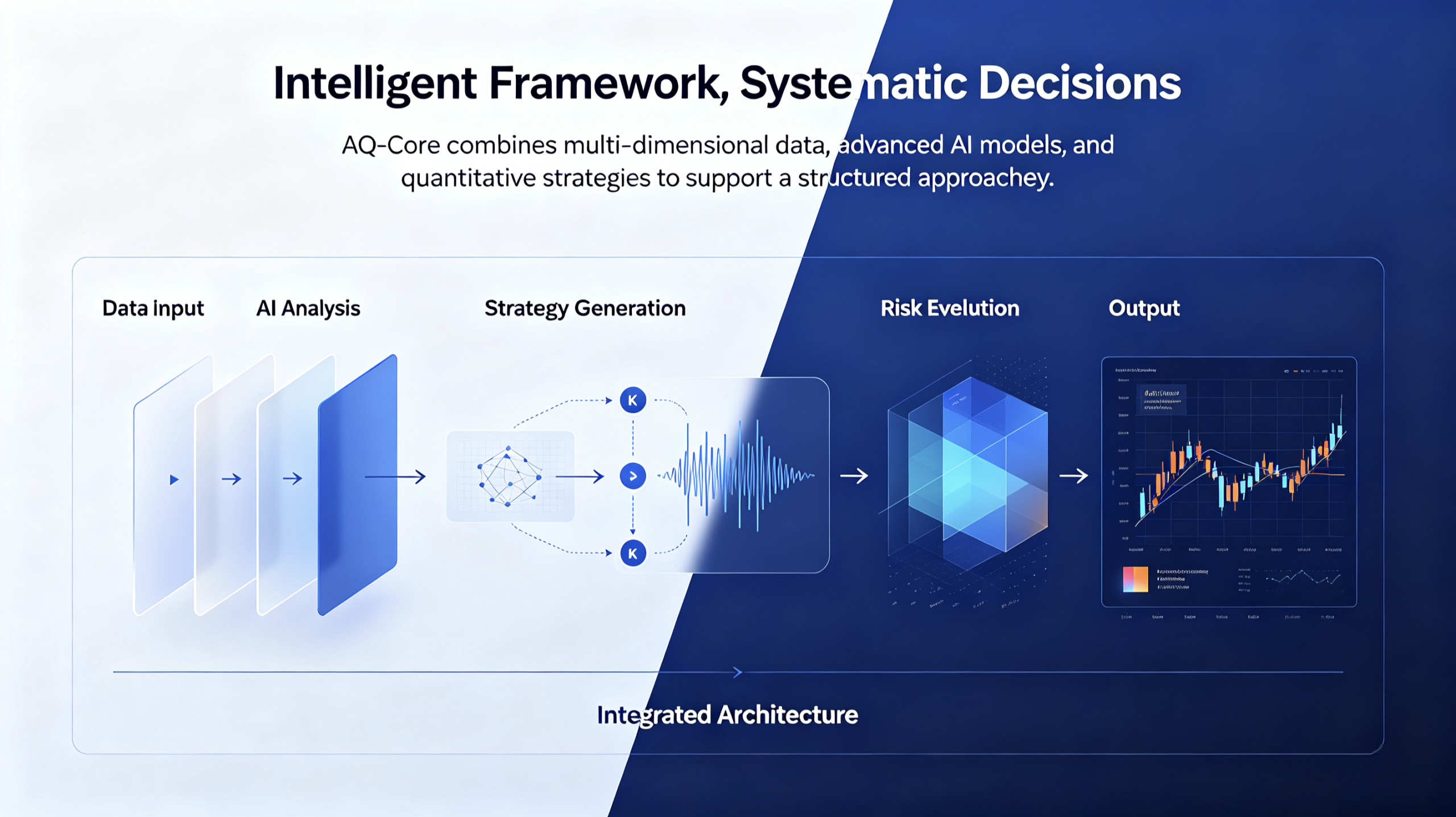
AgentQuant’s core AI framework connects data processing, model analysis, strategy generation, and risk management into one integrated system.
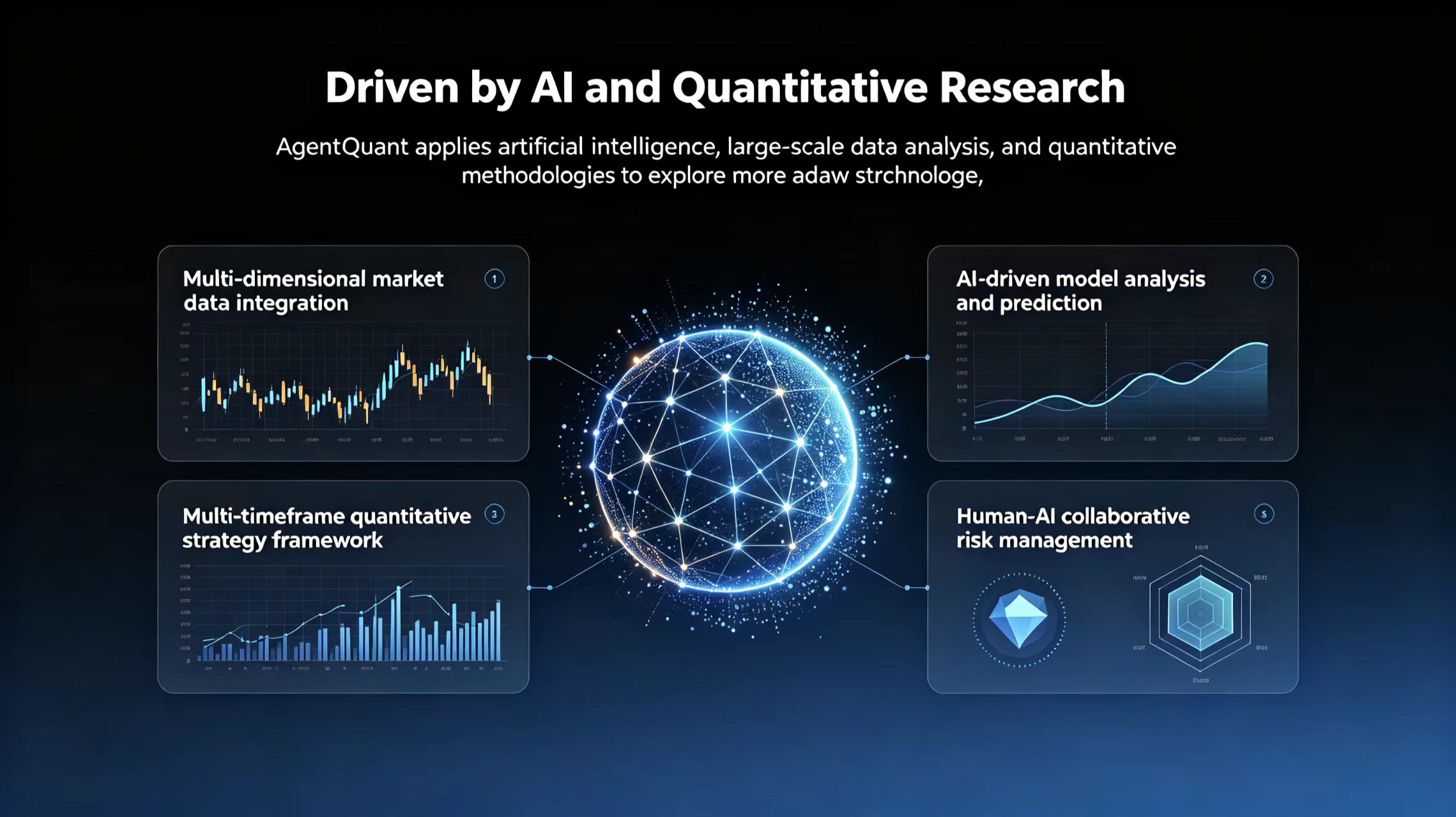
Developing intelligent quantitative models through artificial intelligence, large-scale data analysis, and systematic research methods.
DSM uses AI-driven analysis to evaluate strategy compatibility and explore more adaptive quantitative participation approaches.
AQ-Prime Allocation™ explores intelligent strategy allocation through market analysis, strategy capacity evaluation, and dynamic allocation mechanisms.
Optimizing strategy implementation through intelligent order management, market condition analysis, execution evaluation, and technology-driven process improvement.
Combining human-defined rules with AI execution to establish structured monitoring and adaptive risk management processes.
Economic indicators and policy information.
Industry and non-traditional market information.
News and market text analysis.
AQ-Core (AgentQuant Core Intelligence) is the foundation of AgentQuant’s AI-Native trading infrastructure, integrating data processing, AI models, strategy development, and risk management into one intelligent framework.
Transformer-based models analyze market sequence patterns.
PPO and SAC methods support strategy optimization.
Processing financial reports, research materials, and market information.
To become a leading AI-Native quantitative technology company, recognized for intelligent trading infrastructure, systematic research, and innovative approaches that connect artificial intelligence with financial markets.
To combine artificial intelligence, large-scale data analysis, quantitative models, and risk management systems into an integrated technology framework that supports the development of more systematic, transparent, and intelligent trading infrastructure.
AgentQuant develops AQ-Launch™ as an intelligent strategy framework that connects AI-driven analysis, strategy matching, and dynamic allocation mechanisms. The system is designed to explore more adaptive approaches to quantitative strategy participation through AQ-Core intelligence.
AgentQuant applies data-driven analysis and structured allocation mechanisms based on strategy conditions, market environment, risk parameters, and strategy capacity.
DSM Dynamic Strategy Matching
DSM evaluates strategy compatibility through market conditions, user risk profiles, capital characteristics, historical participation data, and strategy requirements.
The framework explores a transition from standardized strategy delivery toward more adaptive and intelligent strategy matching.
AQ-Prime Allocation™ is AgentQuant’s proprietary strategy allocation mechanism designed around strategy capacity and market opportunity conditions.
Application → Matching → Allocation
When AQ-Core identifies specific market structure conditions, eligible strategy opportunities may be evaluated through a structured allocation process.
AgentQuant supports different quantitative strategy horizons through its AI-Native framework.
AgentQuant combines AI execution capabilities with human-defined rules to support structured risk management throughout strategy operations.
AgentQuant develops multi-timeframe quantitative strategy frameworks through AQ-Core intelligence, covering different market cycles, strategy objectives, and quantitative applications.
Product | Period | Strategy Focus |
AQ-Alpha | 1 Trading Day | Intraday Market Microstructure Strategies |
AQ-Momentum | 3-10 Trading Days | Momentum & Event-Driven Strategies |
AQ-Balanced | 25-60 Trading Days | Multi-Factor Rotation Strategies |
AQ-Vision | 90-240 Trading Days | Fundamental Quantitative & Macro Strategy Frameworks |
Designed for short-term quantitative applications, AQ-Alpha focuses on intraday market microstructure analysis and short-window market opportunities through AQ-Core intelligence.
AQ-Momentum analyzes short-term market trends and event-driven factors to support dynamic strategy research across changing market conditions.
AQ-Balanced combines multi-factor analysis and risk-adjusted allocation methods to explore balanced strategy frameworks across different market environments.
AQ-Vision integrates fundamental analysis, macro factors, and long-term market perspectives to support longer-cycle quantitative strategy research.
AgentQuant establishes a progressive membership framework designed to connect member development with strategy participation, product eligibility, and broader platform access.
The seven-level structure provides a clear development path while allowing participation conditions to evolve according to applicable activity, qualification, and team-development requirements.
|
Level
|
Position Utilization
|
Single-Track Limit
|
Multi-Track Limit
|
|---|---|---|---|
|
VIP1
|
45%
|
3,000 USDC
|
Not Available
|
|
VIP2
|
55%
|
6,000 USDC
|
10,000 USDC
|
|
VIP3
|
60%
|
10,000 USDC
|
20,000 USDC
|
|
VIP4
|
65%
|
20,000 USDC
|
40,000 USDC
|
|
VIP5
|
70%
|
50,000 USDC
|
80,000 USDC
|
|
VIP6
|
80%
|
100,000 USDC
|
160,000 USDC
|
|
VIP7
|
90%
|
200,000 USDC
|
300,000 USDC
|
Membership development is designed to provide a structured way of organizing different participation stages rather than applying the same access conditions to every member. Each level forms part of a broader framework connecting membership status with AgentQuant’s strategy ecosystem.
AgentQuant organizes its regular product framework around different participation periods, eligibility conditions, allocation arrangements, and product structures.
Rather than applying one standardized product format, the framework provides multiple participation options designed for different membership stages and applicable product conditions.
|
Product Zone
|
Daily Rate Range
|
Product Period
|
Eligibility
|
User Share
|
Management Fee
|
Distribution
|
|---|---|---|---|---|---|---|
|
V1
|
1.1%–1.6%
|
1–30 Days
|
VIP1+
|
65%
|
35%
|
Principal & earnings at maturity
|
|
V2
|
1.3%–1.7%
|
7–45 Days
|
VIP2+
|
70%
|
30%
|
Principal & earnings at maturity
|
|
V3
|
1.4%–1.8%
|
7–60 Days
|
VIP3+
|
73%
|
27%
|
Principal & earnings at maturity
|
|
V4
|
1.5%–1.9%
|
15–60 Days
|
VIP4+
|
76%
|
24%
|
Multi-structure distribution
|
|
V5
|
1.8%–2.1%
|
15–75 Days
|
VIP5+
|
80%
|
20%
|
Multi-structure distribution
|
|
V6
|
2.1%–2.4%
|
30–90 Days
|
VIP6+
|
83%
|
17%
|
Multi-structure distribution
|
|
V7
|
2.4%–2.7%
|
30–90 Days
|
VIP7+
|
86%
|
14%
|
Multi-structure distribution
|
|
M5
|
2.5%–2.8%
|
30–120 Days
|
M5+
|
90%
|
10%
|
Multi-structure distribution
|
|
M6
|
2.7%–3.0%
|
30–180 Days
|
M6+
|
93%
|
7%
|
Multi-structure distribution
|
|
M7
|
3.3%–3.5%
|
30–360 Days
|
M7+
|
95%
|
5%
|
Multi-structure distribution
|
Each product category follows its own participation rules and operating parameters, helping members identify the product conditions associated with their applicable level and participation status.
Alongside regular product categories, AgentQuant may introduce selected limited-allocation opportunities under specific market periods, events, or operating conditions.
These products are designed around limited capacity and defined participation windows, with availability determined by applicable product conditions rather than continuous access.
|
Product
|
Rate Structure
|
Product Period
|
Level Requirement
|
User Share
|
Management Fee
|
Distribution Method
|
Allocation Method
|
|---|---|---|---|---|---|---|---|
|
Limited Allocation Zone
|
Generally More Than 2× Regular Products
|
Generally Within 30 Days
|
No Level Requirement
|
80%–90%
|
20%–10%
|
Multi-Structure Distribution
|
Random Allocation
|
Limited products operate separately from the regular product framework and may follow different eligibility, allocation, and participation arrangements depending on the applicable release conditions.
AgentQuant establishes a structured development framework that connects team growth, member activity, qualification assessment, and applicable platform rewards.
The M1–M7 progression provides a defined pathway for recognizing different stages of team development while maintaining clear qualification and assessment conditions.
|
Level
|
15-Day Periodic Reward
|
Growth Reward
|
Monthly Distribution
|
|---|---|---|---|
|
M1
|
50 USDC
|
100 USDC
|
None
|
|
M2
|
100 USDC
|
200 USDC
|
None
|
|
M3
|
200 USDC
|
300 USDC
|
None
|
|
M4
|
400 USDC
|
900 USDC
|
1%
|
|
M5
|
800 USDC
|
3,000 USDC
|
2%
|
|
M6
|
1,600 USDC
|
10,000 USDC
|
4%
|
|
M7
|
3,200 USDC
|
50,000 USDC
|
8%
|
Advancement within the framework is based on applicable development requirements rather than automatic level progression. Each stage represents a different level of team development and corresponding platform participation.
Active-member qualification provides a defined reference for membership progression, team assessment, and applicable participation rights within the AgentQuant membership framework.
To qualify as an active member, a member must maintain an eligible product position for at least three days during the applicable assessment period.
Eligible participation may be recognized according to T+0 timing rules.
Eligible participation may be recognized according to T+1 timing rules.
Active status is not treated as permanent qualification. Applicable membership and team conditions are reviewed periodically based on actual eligible participation.
AgentQuant establishes defined qualification requirements for members seeking to participate in applicable agent or market-development roles.
Eligible applicants should meet the following general requirements:
Applicants should maintain valid active-member status under the applicable platform rules.
Applicants should understand AgentQuant’s operating model, development direction, and applicable participation framework.
Applicants should be familiar with platform procedures, membership levels, product participation, and applicable member benefits.
Applicants should be able to cooperate with applicable market-development, communication, and operational arrangements.
Agent participation is subject to applicable review and approval requirements and does not become effective solely through membership status.
The M1–M7 framework connects team development with qualification assessment, periodic rewards, growth rewards, and applicable monthly distribution arrangements.
Advancement within the framework is based on actual eligible-member development and applicable assessment requirements rather than automatic progression.
Team development is reviewed through a 15-day assessment cycle, with applicable growth requirements evaluated according to actual eligible-member conditions.
Applicable periodic rewards are generally processed according to the defined operating cycle, including scheduled assessment and distribution periods.
Growth rewards are linked to applicable M-level advancement conditions and may only be received once for each qualifying level.
M-level status is reviewed according to the actual number and qualification status of eligible active members during the applicable assessment period.
Applicable M1 and M2 assessment conditions may follow the specific transitional arrangements defined under the current operating rules.
Applicable periodic rewards may be processed around the 1st and 15th of each month, subject to qualification review and platform operating conditions.
AgentQuant applies structured withdrawal procedures designed to organize withdrawal eligibility, processing intervals, account changes, and applicable security controls.
New members must complete at least three days of eligible strategy participation before submitting an applicable withdrawal request.
A new withdrawal request cannot be submitted while another eligible withdrawal remains pending for processing.
After an applicable withdrawal has been credited, a waiting period of approximately 48 hours applies before another withdrawal request may be submitted.
Changes involving applicable KYC information, transaction passwords, or withdrawal addresses may require a 48-hour security waiting period before withdrawal functionality becomes available again.
Members who meet the applicable no-withdrawal period requirement for 15 days may qualify for one withdrawal-fee exemption according to the applicable platform rules.
Account activity may be reviewed using applicable account-identification and security information.
AgentQuant applies structured review, calculation, and data-management procedures to support the administration of eligible team and membership-related rewards under applicable platform rules.
Management Area | Description |
Contribution Review | Reviews eligible team contribution records. |
Reward Calculation | Applies the corresponding membership reward rates. |
Data Management | Excludes abnormal data or records that do not meet applicable requirements. |